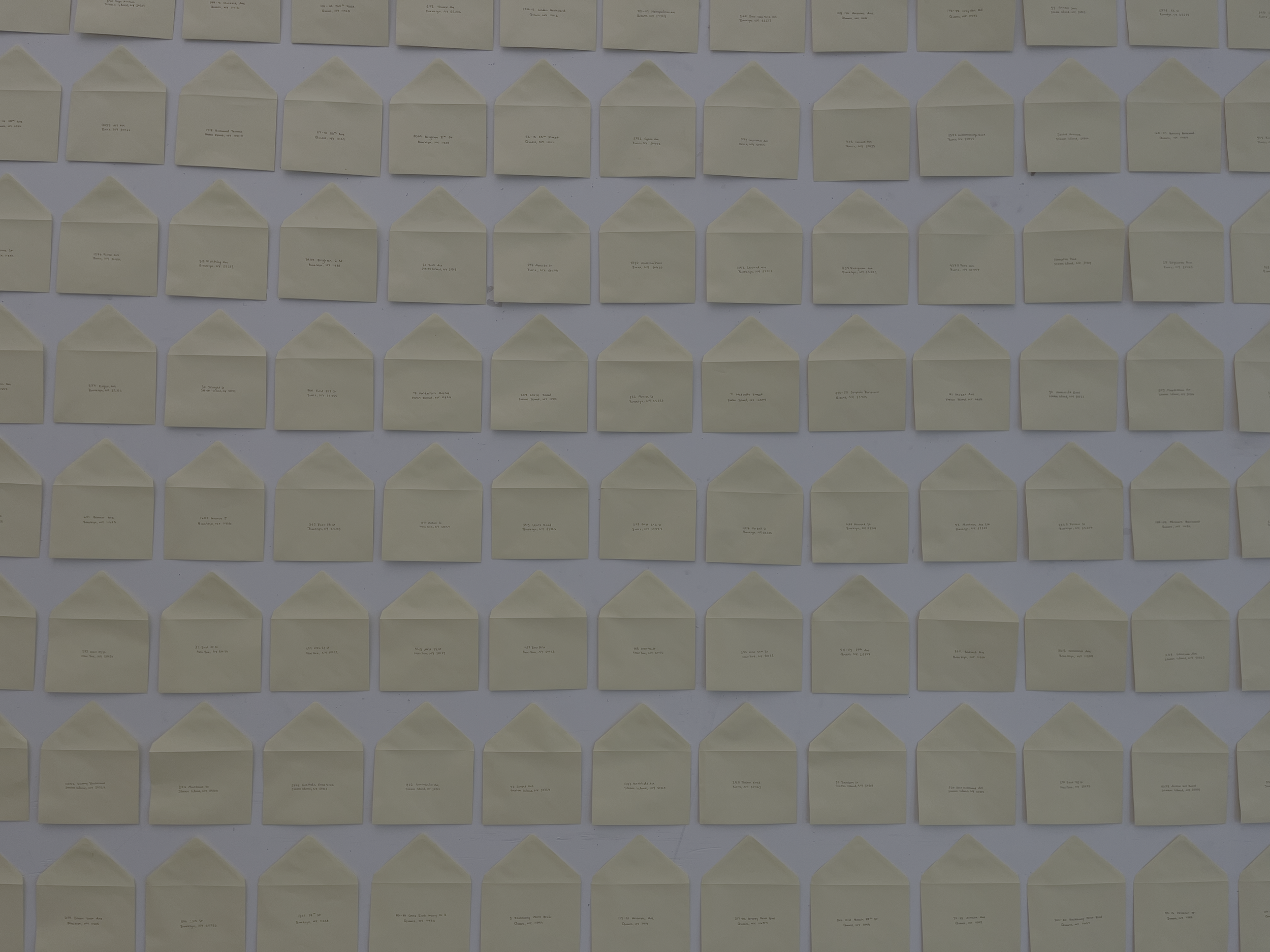
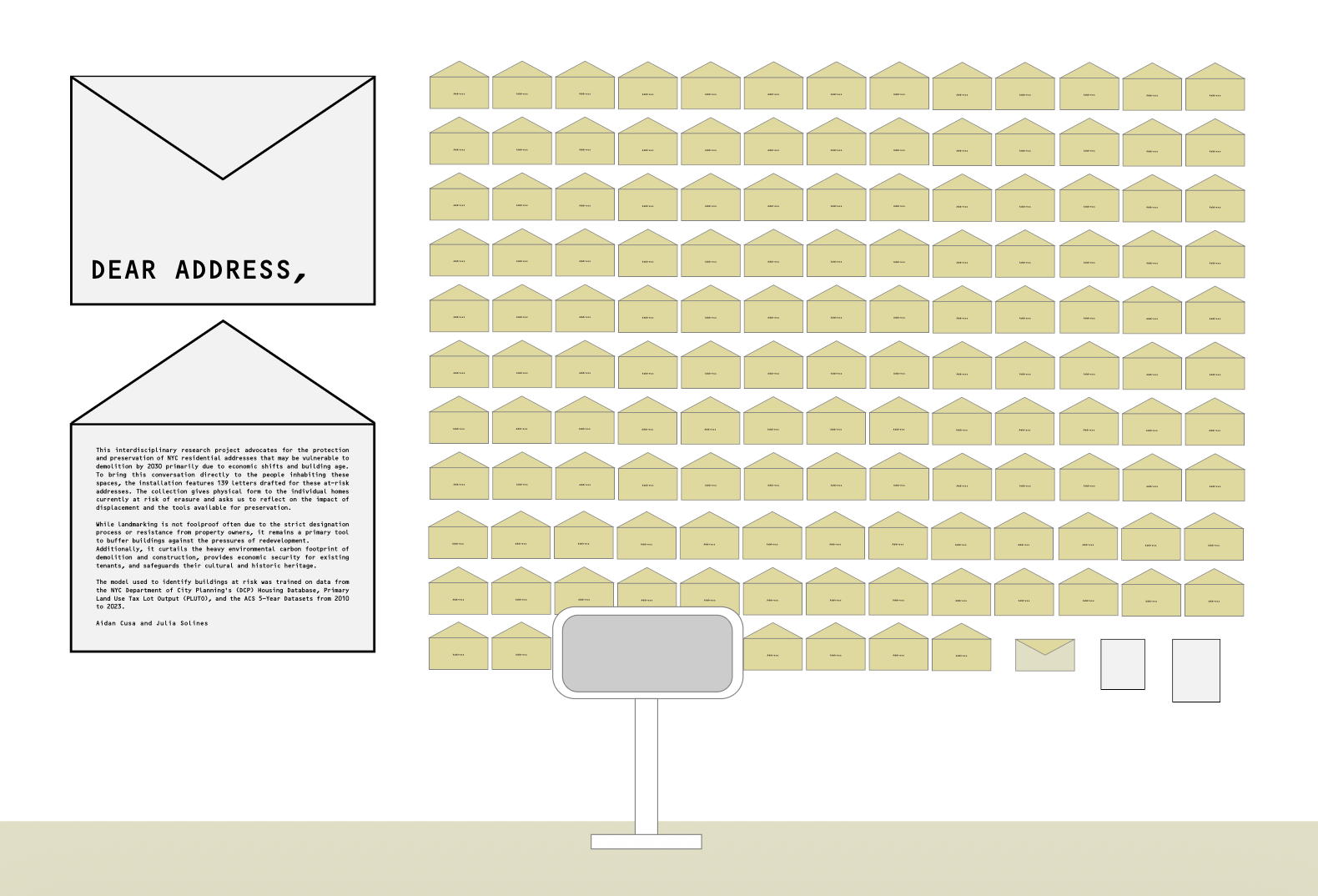
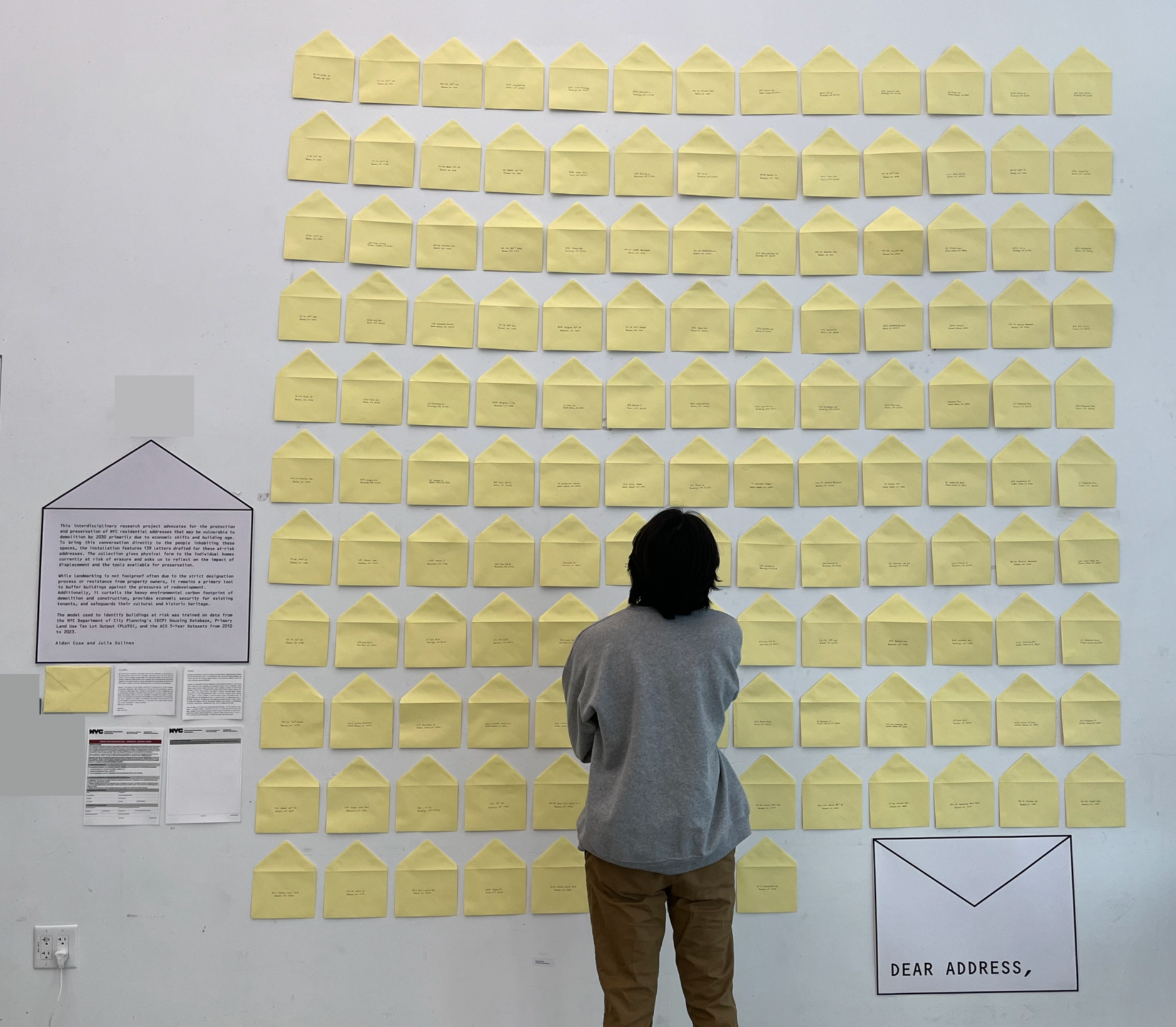
This interdisciplinary research project advocates for the protection and preservation of NYC residential addresses that may be vulnerable to demolition by 2030 primarily due to economic shifts and building age. To bring this conversation directly to the people inhabiting these spaces, the installation features 139 letters drafted for these at-risk addresses. The collection gives physical form to the individual homes currently at risk of erasure and asks us to reflect on the impact of displacement and the tools available for preservation.
While landmarking is not foolproof often due to the strict designation process or resistance from property owners, it remains a primary tool to buffer buildings against the pressures of redevelopment. Additionally, it curtails the heavy environmental carbon footprint of demolition and construction, provides economic security for existing tenants, and safeguards their cultural and historic heritage.
The model used to identify buildings at risk was trained on data from the NYC Department of City Planning’s (DCP) Housing Database, Primary Land Use Tax Lot Output (PLUTO), and the ACS 5-Year Datasets from 2010 to 2023.
The Model
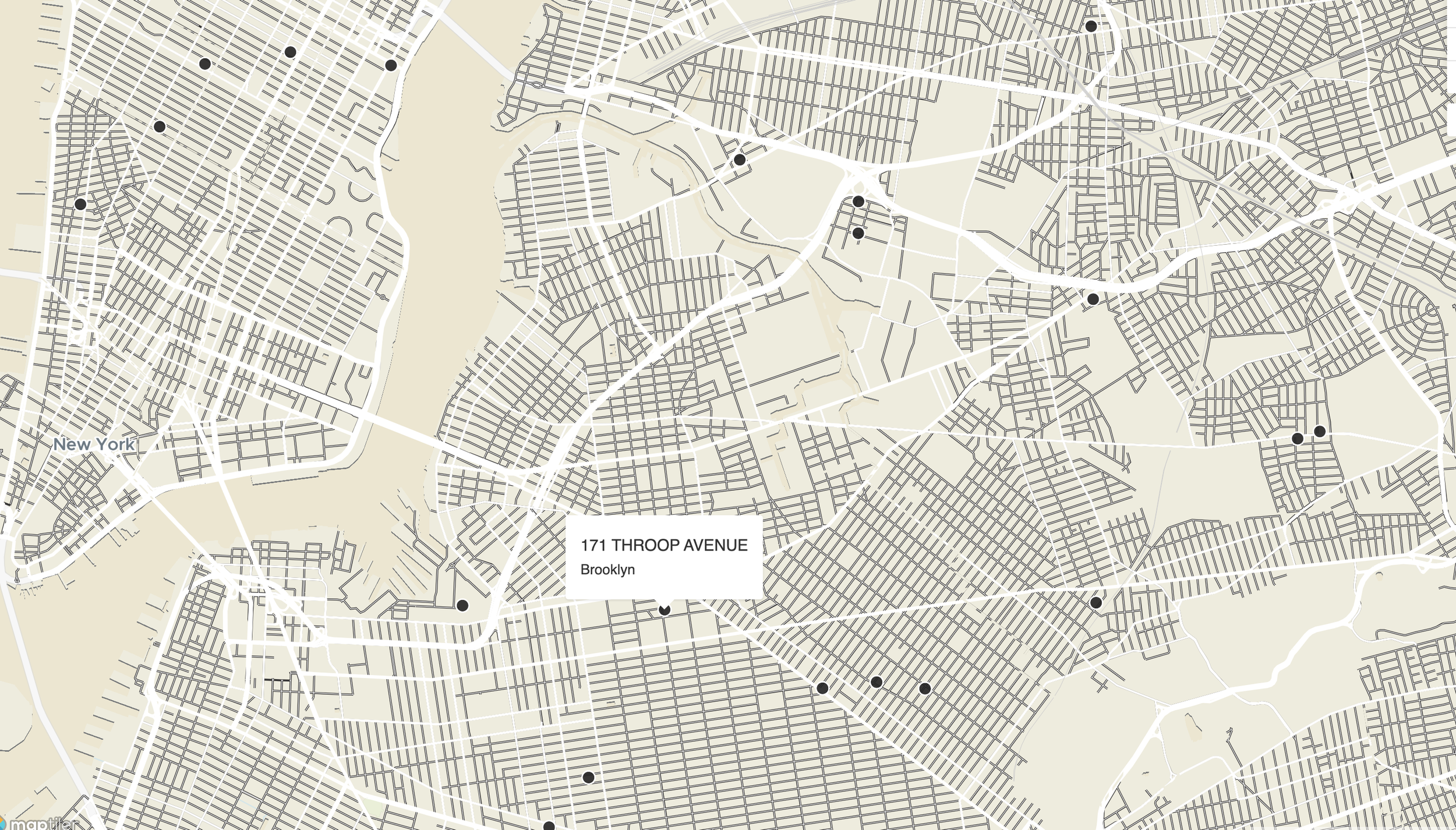
The combination of data from multiple different datasets from the NYC Open Data Portal led to the creation of our own dataset for BUD (Building Under Demolition) Machine Learning Model to be trained with. Including NYC Housing Database, the NYC Primary Land Use Tax Lot Output Dataset and the NYC American Community Survey Datasets from 2010-2023.
From each Census tract in NYC, we obtained demographic data such as total population, gender, race, median income, number of people in poverty, median home value, number of renters, etc. Then, we calculated aggregated features like: % white, % black, % renters, % citizen, vacancy rate, % of each gender, % in poverty, etc. The PLUTO Dataset has information on every Borough-Block-Lot (BBL) in the city such as zoning district, building class, number of floors, historical district, landmark, number of buildings, etc. The PLUTO Dataset was then merged with the ACS Dataset to match each Borough-Block-Lot with corresponding demographics from the past 13 years from 2010-2023, noting how these have changed over time. Finally, the NYC Housing Dataset, containing all NYC Department of Buildings (DOB) approved housing alteration, construction and demolition jobs filed or completed in NYC since 2010, merged with the ACS & PLUTO dataset.
We used a Gradient Boosted Tree Classifier on seven different models, trained to flag whether a demolition will occur within each building in the next 5 years. Since the NYC Housing Database has data up until 2025, the data could be used to compare the predictions of the model. Demolition predictions resulted in a 0.78 F1 score, meaning that it predicted these demolitions with 78% accuracy.